
Assignment Part 1


(A) Rationale
In this lesson, a primary two student of Thai and Malaysian Chinese descent was selected to participate in this lesson on the origin of 12 simple mandarin characters. This student was chosen because he attended mandarin classes outside of school, but found Chinese characters difficult to recognize and read. Due to not being successful in learning Mandarin, he has since stopped learning Mandarin.
There are three learning outcomes of this lesson. The first learning outcome is to help learners remember the simplified drawings of the items like the sun and wood which makes the origin of their Chinese characters. With the first learning outcome achieved, the learners then move on to understanding how the characters come about which will make recognizing the characters easier during the final task - which is the second learning outcome of this lesson. These two learning outcomes are parallel to the first two levels from Bloom's Taxonomy which is remembering and understanding. The final learning outcome is to retain the knowledge learned.
(B) Lesson Plan
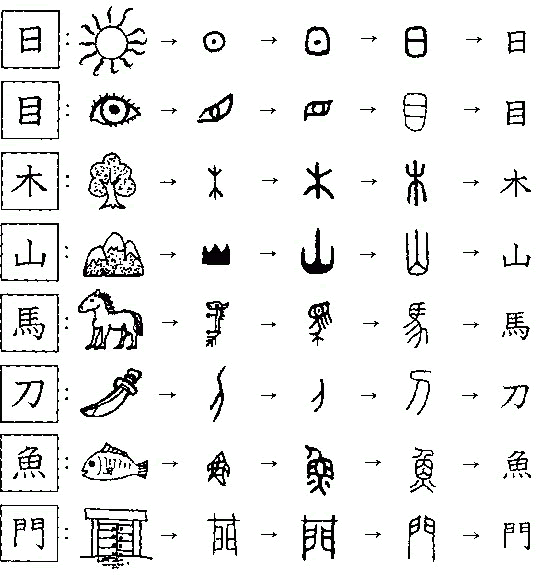
The 12 characters includes : sun, moon, cloud, door, knife, bright, mountain, wood, a person, an eye, rain and water
Resources used:
Source: Tom Thompson : Chinese Language Myths
Source: Nihongo Lesson: The Kanji
As an introduction, the learner is asked to draw a simple drawing of the 14 characters. The learner is asked : "What do you think the sun looks like in a very simple drawing?" After the first task, learner is then shown the drawing of the 14 items from the ancient days. In the second task, the learner is then asked to draw according to the pictures shown to them. In the third task, the learner is shown the Chinese characters of the 14 items. In the fourth task, the learner is given two sets of cards. One set consist of the drawing of the items and the second set contains the actually Chinese character. The learner is then asked to match the drawing to their respective Chinese characters. In the final task, learner is asked to recognize each of the Chinese characters through a verbal quiz. To test the retention of knowledge, the learner is asked to participate in the verbal quiz again the next day.
(C) Evidence of Lesson Conducted


(D) Reflection
One key point I took from this lesson is the importance of understanding with the addition of the fun factor. This is especially important when a child is taught a new or foreign concept. It is like a warm up before going for a run. If I were to look back at my primary school days, learning equals memorization. Let's not even talk about 'fun'. Now that I am an educator, I always ask myself: "How would I like to learn it if I was an eight year old child?". Fun was the key for me, and when the most mundane of tasks are made fun, it would be memorable. The same goes for learning. Pavlov once said: "Don't become a mere recorder of facts, but try to penetrate the mystery of their origin."
Coming from a behaviourist background, I truly believe that reinforcements play a huge role in our daily lives. Children work hard to score A's to seek approval from parents and even as adults, we work hard to earn a better living. I also agree that children start off as a clean slate as behaviourist like Skinner (2011), Pavlov(1902) and Watson (2013) suggests. Reinforcements, both positive and negative will affect the likelihood of the behaviour occurring again. However, for me personally intrinsic rewards are the best as I learn to see beyond the physical benefits such as gifts or money. This is an important value and children should be taught to see the bigger picture than purely focusing on the A's. Rather than focusing on gifts, children also respond well to verbal reinforcements such as 'I like that you are trying hard!' and 'well done for focusing on your task!'. Research (Morris & Zentall, 2014) showed that verbal praises increases resilience.
I think this task was not only intrinsically rewarding due to the reason that it is a game, and also made appropriate for his level, it also opened my learner's eye to see that learning is not a boring task. Learning can be made fun and you will be able to retain the information better when you are enjoying the process. This does not mean that learning should always include games, but it teaches him (referring to this one particular learner) to also enjoy the Math worksheets he have to do over and over again in order for him to understand what and why he is learning. It is beyond getting the answers right, but understanding what different question wants from him and navigating through the questions to obtain the correct answer.
References
- Bloom, B. (1956). Taxonomy of Educational Objectives Handbook I: The Cognitive Domain. New York: David McKay Company, Inc.
- Morris, B. J., & Zentall, S. R. (2014). High fives motivate: the effects of gestural and ambiguous verbal praise on motivation. Frontiers in Psychology, 5. doi:10.3389/fpsyg.2014.00928
- Nihongo Lesson: The kanji – one symbol, one meaning. (2017, July 22). Retrieved November 08, 2017, from http://leadgroupph.com/kanji-one-symbol-one-meaning/
- Pavlov, I. P. (1902). The work of the digestive glands. London: Griffin.
- Skinner, B. F. (2011). About behaviorism. Vintage.
- Thompson, T. (n.d.). Chinese Language Myths. Retrieved November 08, 2017, from http://www.omniglot.com/language/articles/chinesemyths.html
- Watson, J. B. (2013). Behaviorism. Read Books Ltd.
Assignment Part 2
Everyone has a cultural identity, but what does it actually means? To some people, it could be strongly connected to their birth heritage. But to others, it could be a local club or a sports team that they are part of. Cultural identity for me personal leans towards the former than the latter. This includes my personal beliefs, values, the languages I speak, customs and style of dressing that defines who I am and also shape my lifestyle.
First and foremost, I am of Chinese descent. Both my parents and grandparents are Chinese. My great grandparents, whom I am very fortunate to have met and known, are from China. Even though I am born and raised in Malaysia, I am taught from a young age to call myself a Chinese. I went to a Chinese vernacular primary school and a predominantly Chinese secondary school. I would also have to select Chinese as my race when completing any sort of forms. As Chineses, my family and I would celebrate Chinese New Year and all the other practices that comes along with it such as the reunion dinner on the eve, visiting relatives and giving and receiving red packets.
Secondly, I am also a Christian. I am brought up in a Christian home where prayer and attending church every Sunday is very important. At a very young age, I am taught to always rely on God and not my own personal strength. Being a Christian is more than just a religion but it is a relationship that I have with God.
Thirdly, I come from a middle income background. I am very privileged that both my parents are always home for dinner and have time to bring me and my siblings for both local and international holidays. I also had the opportunity to study abroad. My mother and father come from very humble beginnings. Starting a family at a young age of 22 and 23 respectively, they worked hard but never neglected family time which was very important for them. My parents would always remind my siblings and I that money can never replace family love.
At the current stage of my life, these are the factors that influence the decision I make in my daily live. Out of the three cultural identities I identify with, being a Christian has the most significant impact in my live. It is also the at the center of all the other factors affecting my identity - which will be explained further in the paragraph to come. As mentioned above, being a Christian is more than just believing in a religion. It becomes a way of life, and it acts as a compass as to who I am looking up to and where I should be heading towards. I am always reminded that my strength is not my own and everything I do it should be in the image of God. This made sure that I am as responsible as I can be while living on earth, and when the time comes, I will be answerable to God. Niebuhr (2003) outlines what he calls Christ and Culture in Paradox. The dualists are found within this view. The position is dualistic in that the Christian is said to belong to two realms (the spiritual and temporal) and must live in the tension of fulfilling responsibilities to both.
As mentioned above, being a Christian becomes a way of live. This also affects how I am taught to spend my money. At a very young age, my parents always teach me to give sacrificially and of course at a young age, I never understood what that really meant. My parents would always give me a one Ringgit note to put in the offering bag when at Sunday school. I only really understood what 'giving sacrificially' meant when I was in high school, which was also the time when I understood what 'earning money' meant as my mum started her own jewelry and clothing business and I would earn some pocket money which taught me the value of a dollar.
Since then, I would not ask for money unless given, as I understood that what I need was being provided for. I would remember my dad asking me if I have enough money to use, even up to this day, as he knows I try my best to be independent and work with the budget I have rather than asking for money.
Surprisingly, even though I identify myself as a Chinese, it seems to have the least impact on my live. This could be due to the fact that I grow up reading more English books, and spoke more English at home. My friends and I would also converse in English more as I remember growing up, speaking English meant that I was cool. Even though I spent 6 years in a Chinese vernacular school where I spoke Mandarin with my friends, listened to Chinese songs from Jay Chou and F4, I think I really started to mould my identity when I was in high school, which according to Erikson (1965), is the adolescent stage. According to Erikson (1965), the adolescent stage (between ages 13-19) is when we are concern of how people perceive us.
In conclusion, even though I have identified myself with different social and cultural identities, I can now see how each plays a different role in my life. This reflection has allowed me to take a pause from my hectic schedule to see how I have become who I am today.
References
1. Erikson, E. (1956). The problem of ego identity. Journal of the American Psychoanalytic Association. 4: 56–121. doi:10.1177/000306515600400104.
2. Niebuhr, H. R. (2003). Christ & culture. New York: HarperCollins World.

No comments:
Post a Comment